
Data Recovery in the age of A.I.
This is going to be an interesting article to write. Data Recovery and A.I., since the 5.5 models were released the amount of advancements in the field of flash memory data recovery has exponentially increased the capabilities of what’s now possible to recover.
Lately we’ve been inundated with old bit rot cases. Essentially electrons leak from NAND cells over time which can turn a 3 into a 1 or 0 which corrupts the data in the NAND chip. Most NAND chips from the last decade support Read Retry Profiles or Voltage Offset tuning so that you can adjust the sensitivity of a flash chips NAND gate and bring that 1 or 0 up to a 2 or 3 again.
Even the best data recovery software for data recovery companies has trouble reviving bit-rot cases, either they don’t support the read retry protocol or the amount of retries needed to read the flash memory chip was unrealistic and the way they implemented read-retry required reading the entire memory chip many times to repair one area.
For fun and giggles I wrote a MCP to interface Claude Code with our NAND readers. Let the fun begin. With minimal prompting it has solved dynamic XOR encryption codes, reverse engineered BCH parameters, found and reverse engineered read retry / voltage offset protocols, page grouping, FTL mapping by the controller and for it’s latest trick bringing all that together to implement soft-decisions on a BCH error correction algorithm allowing it on the fly to correct bit-rot errors.
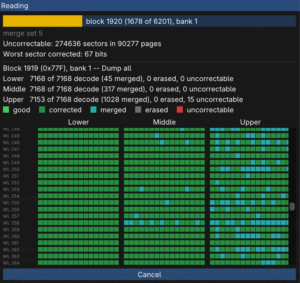
There are rumblings in the data recovery community solving LDPC error correction codes using AI and cracking some previously thought unbreakable cases going decades without a solution. The pace at which advancements are being made is insane.
Here’s an example of the soft-decisions algorithm AI drempt up for us. Green = Sectors normally correctable by standard read retry / voltage offset protocols. Aqua = errors corrected by soft-decisions.
Impressive, it’s going to be interesting to see what problems A.I. is going to be able to solve (or create) for us in the up-coming year.
