
SanDisk Ultra Flair SDCZ73-128G Data Recovery
SanDisk Ultra Flair SDCZ73-128G-G46 – Monolithic Flash Drive Data Recovery
A customer sent us their SanDisk Ultra Flair USB 3.0 flash drive (model SDCZ73-128G-G46) after it suddenly stopped working. When plugged into a computer, the drive would make a sound as if it were trying to connect — the familiar USB connection chime would play — but no drive letter ever appeared. This happened on both Windows and Mac. The drive contained important files with no backup, and the customer needed the data recovered.
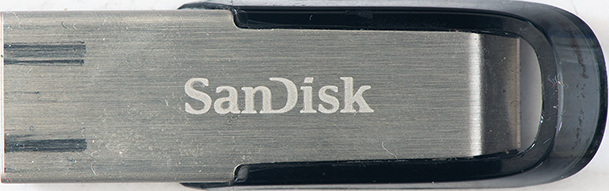
SanDisk Ultra Flair USB 3.0 SDCZ73-128G-G46 – Front
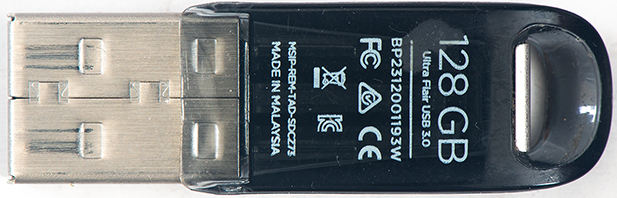
SanDisk Ultra Flair USB 3.0 SDCZ73-128G-G46 – Back
What Is a Monolithic Flash Drive?
The SanDisk Ultra Flair SDCZ73 is a monolithic flash drive. Unlike traditional USB drives that have a separate circuit board with a controller chip, NAND memory chip, and other discrete components, a monolithic drive integrates everything — the USB connector pads, the controller, and the NAND flash memory — into a single chip package. There is no removable or repairable PCB inside.
This design makes the drive compact and durable under normal use, but it also means that standard data recovery methods like swapping a controller or reflowing solder joints do not apply. When a monolithic flash drive fails, recovery requires direct communication with the NAND flash memory at the chip level — bypassing the controller entirely and reading the raw data from the memory cells.
Why the Drive Made Connection Sounds but Had No Drive Letter
When the customer plugged in the SDCZ73-128G-G46, the computer detected USB activity — enough to trigger the connection sound — but the drive never fully enumerated. No drive letter appeared in Windows Explorer or Disk Management, and no volume mounted on Mac. The drive was effectively invisible to the operating system despite showing signs of electrical life.
Our diagnosis determined the root cause: degradation of data inside the NAND flash memory chip, commonly known as bit rot. The controller was receiving power and attempting to initialize, but it could not successfully read the internal firmware and flash translation layer (FTL) data it needed from the NAND to present a usable storage volume to the host computer.
Understanding Bit Rot in NAND Flash Memory
NAND flash memory stores data by trapping electrons inside microscopic floating-gate transistor cells. Each cell holds a specific charge level that represents one or more bits of data. Over time — or after a large number of write cycles — those stored electrons can leak out of the cells through a process called charge loss. When enough charge is lost, the data stored in those cells becomes unreliable or unreadable.
This degradation is referred to as bit rot, and it affects all flash-based storage to some degree. Several factors accelerate the process:
- Age — Flash memory cells lose charge naturally over time, even when the drive is sitting unpowered in a drawer. Data retention is finite.
- Write/erase cycles — Every write and erase cycle physically stresses the thin oxide layer that traps electrons. The more cycles a cell has endured, the faster it loses charge.
- Temperature — Heat accelerates electron leakage. Drives stored in hot environments degrade faster.
- NAND type — TLC (Triple-Level Cell) and QLC (Quad-Level Cell) NAND pack more bits per cell by using tighter voltage margins, making them more susceptible to charge loss than SLC or MLC designs.
When the charge levels in enough cells drift beyond the controller’s default voltage thresholds, the controller can no longer distinguish between valid data states. The result is read errors — and if critical areas like the firmware or FTL are affected, the drive fails to initialize entirely.
How We Recovered the Data – Voltage Offset Recalibration
Because the SDCZ73-128G-G46 is a monolithic device, we accessed the NAND flash memory directly at the chip level. The key to recovering data from a drive suffering bit rot is not replacing hardware — the hardware is not broken. The problem is that the default voltage thresholds used to read the NAND cells are no longer aligned with the actual charge levels stored in those cells.
Our recovery process involved:
- Direct NAND access — Interfacing with the monolithic chip to communicate directly with the flash memory, bypassing the failed controller initialization.
- Voltage offset recalibration — Systematically adjusting the read voltage thresholds used to sense the charge in each NAND cell. By shifting these thresholds to match the degraded charge levels, we were able to obtain clean reads from pages that were previously returning errors.
- Multiple-pass reading — Performing multiple read passes with different voltage offsets to achieve the highest-quality data extraction from degraded cells.
- Data reconstruction — Reassembling the raw NAND data, resolving the flash translation layer, and rebuilding the file system to produce the final recovered files.
By recalibrating the voltage offsets to compensate for the charge loss, we were able to successfully read the vast majority of the NAND contents and recover the customer’s data.
Successful Recovery – Majority of Data Returned
We performed a successful recovery of the majority of the customer’s data from this SanDisk Ultra Flair SDCZ73-128G-G46. What appeared to be a dead, unresponsive flash drive turned out to be suffering from NAND-level bit rot — a problem that is invisible to standard diagnostic tools but recoverable with the right equipment and expertise.
Is Your SanDisk Ultra Flair or Monolithic Flash Drive Not Recognized?
If your SanDisk Ultra Flair, Cruzer, or other USB flash drive makes connection sounds but shows no drive letter, or is completely not recognized by Windows or Mac, don’t assume your data is lost. Bit rot and NAND degradation are common failure modes in aging flash drives — and the data can often be recovered by reading the flash memory directly and recalibrating the read parameters.
At Recover My Flash Drive, we specialize in monolithic flash data recovery and NAND-level repair for USB flash drives and SD cards that other services cannot help with. We have been recovering data from flash media since 2007.
We offer a flat-rate price, a 98% success rate, and our “no data, no charge” guarantee means you only pay if we successfully recover your files. Submit your case today or call us at 1-855-374-6263.
