

SHIPPING LABEL
YOUR DATA




Monolithic Flash Data Recovery
Monolithic flash devices are the hardest media to recover data from — and one of our core specialties. When a monolithic USB flash drive, SD card, or MicroSD card fails, the controller and NAND memory are fused into a single chip with no removable components and no standard pinout. Most data recovery companies either turn these cases away or don’t have the tooling to attempt them.
We’ve been recovering data from monolithic devices since 2011 and have developed proprietary pinouts, tooling, and reconstruction techniques that allow us to extract data from hundreds of monolithic chip variants. If your device is monolithic and it’s failed, we can almost certainly help.
What Is a Monolithic Flash Device?
Traditional flash drives and memory cards are built from separate components — a NAND memory chip, a controller chip, passive components, and a connector — all mounted on a small circuit board. When the device fails, a technician can desolder the NAND chip, read it on a flash reader, and reconstruct the data.
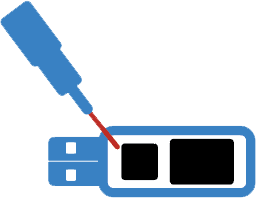
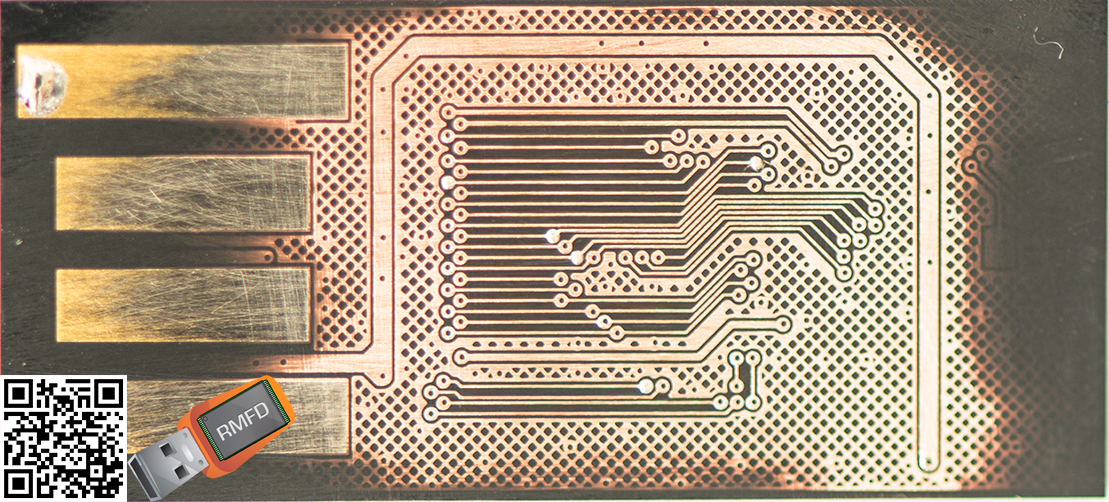
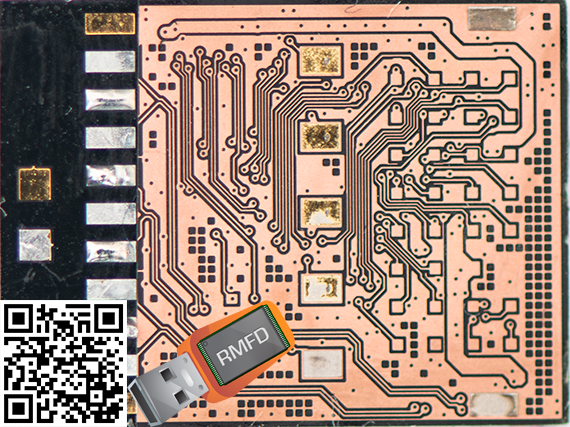
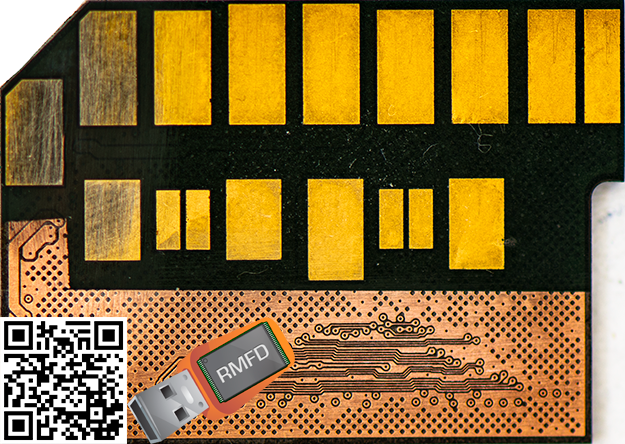
Monolithic devices are fundamentally different. The controller, NAND memory, and interface circuitry are all fabricated onto a single silicon die, then encased in a ceramic or plastic package. There are no removable chips, no accessible solder joints, and no published pinouts. The only way to access the raw memory is to carefully remove the protective coating and make direct contact with the chip’s internal bond pads — microscopic wire traces that vary from one chip design to the next.
This makes monolithic recovery one of the most technically demanding forms of data recovery in the world. Every chip variant requires its own reverse-engineered pinout, and the margin for error is razor-thin.
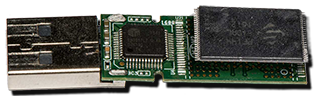
Traditional flash drive (top) — separate NAND chip and controller on a circuit board. The memory chip can be removed and read independently.
Monolithic flash drive (bottom) — all components fused into a single chip package. No removable parts. Recovery requires direct bond pad access.
Recovering data from a monolithic device is a multi-step process that can take anywhere from a few days to several weeks depending on the chip variant and the nature of the failure. Here’s what the process looks like:
Step 1: Identification and Imaging
We identify the chip manufacturer, controller type, and NAND configuration. For known variants in our monolithic pinout database, we can often begin extraction the same day. For unknown variants, reverse engineering the pinout can take several days.
Step 2: Bond Pad Access
The protective solder mask or ceramic coating is carefully removed under magnification to expose the internal bond pads. These pads are typically 50-100 microns wide — smaller than a human hair. We connect fine probe wires directly to these pads to establish a data bus, chip enable, and clock lines.
Step 3: Raw NAND Extraction
Once connected, we read the raw contents of the NAND memory. This produces a binary dump — not usable files, but the raw page-level data stored on the flash cells.
Step 4: Data Reconstruction
The raw dump must be descrambled, error-corrected (ECC), and reassembled. Every controller uses its own algorithms for data scrambling (XOR), page mapping, block management, and wear leveling. We reverse-engineer these algorithms and apply them to reconstruct a usable disk image from which your files can be extracted.
Step 5: File Extraction and Verification
The reconstructed image is mounted and files are extracted. We generate a file list for you to verify before you pay.
Which Devices Are Monolithic?
Monolithic designs are increasingly common and can be difficult to identify from the outside. Many customers don’t know their device is monolithic until a recovery is attempted. Here’s a general guide:
Why is monolithic recovery more expensive than traditional flash recovery?
Traditional flash recovery typically involves desoldering a NAND chip and reading it on a standard flash reader — a process that takes hours. Monolithic recovery requires removing protective coatings, reverse-engineering pinouts (if the chip variant is new), making precision connections to bond pads under magnification, extracting raw data, and then descrambling and reconstructing the data using the controller’s proprietary algorithms. This process can take days to weeks and requires specialized equipment that most data recovery labs don’t have.
Can you recover data from a monolithic MicroSD card?
Yes. All MicroSD cards are monolithic by design, and they’re one of the most common monolithic devices we recover. Whether the card is from a phone, drone, GoPro, dashcam, or camera — if the data is still physically present on the NAND cells, we can extract it. Success rates depend on the nature of the failure and the condition of the NAND memory.
What is your success rate on monolithic recovery?
Monolithic recovery is inherently more difficult than traditional chip-off work, so success rates are lower. However, we maintain one of the highest monolithic success rates in the industry because of our proprietary pinout database and years of experience with these devices. If the NAND cells haven’t degraded beyond readability and we can establish a stable connection to the bond pads, recovery is usually successful. We’ll always be upfront about your chances before you commit.
Another company said my device is unrecoverable. Can you still help?
Probably. Many data recovery companies don’t attempt monolithic recovery at all and will tell you it’s unrecoverable simply because they lack the equipment and expertise. We frequently recover data from devices that other labs — including large national firms — have turned away. If the previous lab didn’t attempt bond-pad-level extraction, there’s a strong chance we can help. Submit a case and we’ll give you an honest assessment.
How long does monolithic recovery take?
One to two weeks is typical. If we’ve already developed the pinout for your specific chip variant, the process is faster. If the chip is a variant we haven’t seen before, reverse-engineering the pinout and data reconstruction algorithms adds time. We’ll give you an estimated timeline once we’ve identified the device.
Will my original files and folder names be preserved?
In most successful monolithic recoveries, yes — we can reconstruct the file system and recover files with their original names and folder structure intact. In cases where the file system metadata is severely damaged, we can still recover the raw file data (photos, documents, video) but the original filenames may be lost and files will be sorted by type instead.
Is there anything I should avoid doing before sending my device?
Don’t attempt to open, scrape, or modify the device yourself. Monolithic chips have extremely fragile bond pads that can be permanently damaged by inexperienced handling. Don’t try running data recovery software on a device that isn’t being detected — it won’t help and can sometimes make things worse. Just package the device carefully and send it to us as-is.
If your flash drive, SD card, or MicroSD card has failed and other companies have turned you away — or if you suspect your device is monolithic — send it to us. We’ve been doing this longer than almost anyone, and we have the tools and pinout library to give your case the best possible chance.
No data, no charge. You only pay if we successfully recover your files.
Questions? Email us at info@recovermyflashdrive.com


